


To fully appreciate the scope of consumer protections available to military families, it is necessary to examine the broader historical and statutory context of the Servicemembers Civil Relief Act (SCRA). Congress passed the SCRA in 2003 as a sweeping modernization of the earlier Soldiers’ and Sailors’ Civil Relief Act of 1940, updating the law to better address the financial realities of the modern era.1 The overarching purpose of the SCRA is to postpone, suspend, or terminate certain civil and financial obligations so that active-duty personnel can focus entirely on the defense needs of the nation without adverse consequences at home.
While various sections of the SCRA handle protections related to residential evictions, automotive leases, and maximum interest rate caps, Section 3956 of the SCRA governs the termination of specific consumer contracts. Enacted to relieve financial stress during mandatory transitions, this statute dictates that service providers are strictly prohibited from imposing any early termination charges, fees, or penalties when a servicemember lawfully cancels a covered agreement.
This federal right is activated when a servicemember receives military orders to relocate for a period of no less than 90 days to a destination that does not support the existing contract. Additionally, the statute covers scenarios where a servicemember enters into a contract after receiving PCS orders but subsequently faces a military stop-movement order—lasting at least 30 days due to a national or global emergency—that prevents them from utilizing the contracted services. In the event that a servicemember incurs a catastrophic injury, illness, or passes away while in military service, these termination rights automatically extend to their spouse or dependents.
The 2023 Amendment: Closing the Home Security Loophole
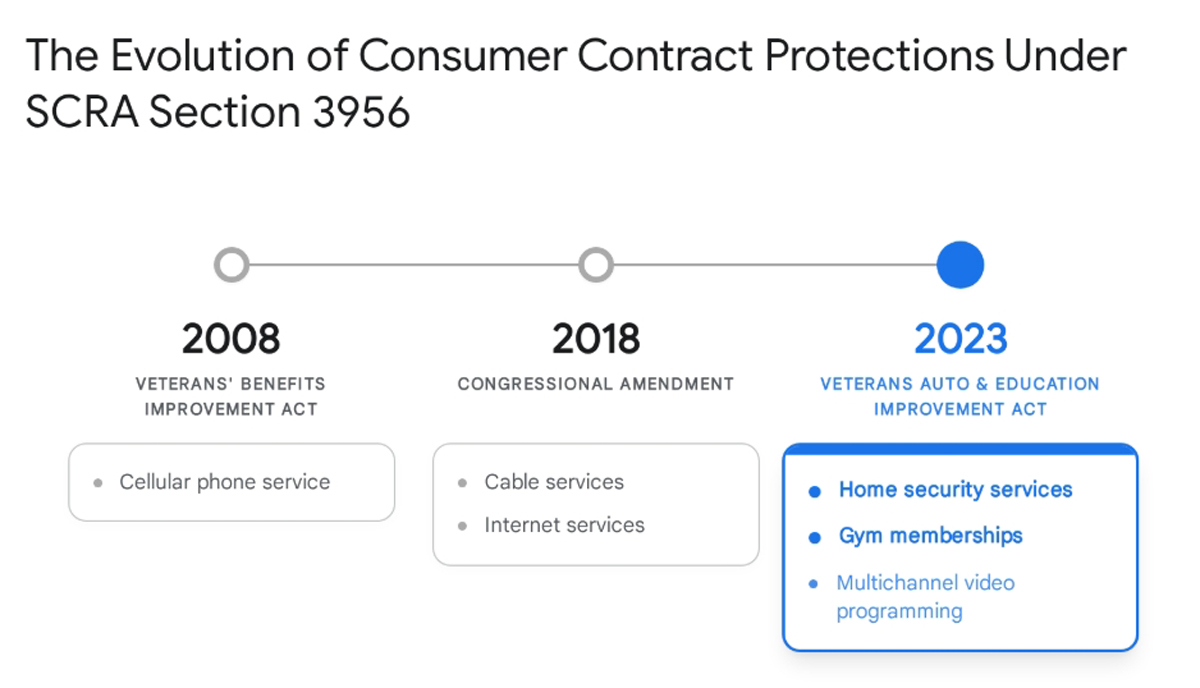
Historically, the right to execute a contract termination under SCRA applied predominantly to telecommunications—specifically cellular phone plans, landline telephone exchanges, internet access, and multichannel video programming (cable and satellite television). Because the statutory text was highly specific, companies operating outside of those defined categories frequently exploited the gray area. Home security providers, in particular, were known to trap transitioning military families in rigid, multi-year monitoring agreements.13 When a servicemember received deployment orders, these security companies routinely refused to cancel the contracts or demanded exorbitant buy-out fees, arguing that their services were not explicitly regulated by the SCRA.
Congress decisively closed this corporate loophole by passing the Veterans Auto and Education Improvement Act of 2022 (Public Law 117-333). Enacted on January 5, 2023, Section 17 of this legislation officially amended Section 3956 of the SCRA to expand the definition of covered consumer contracts. The updated statute explicitly added gym memberships, fitness programs, and home security services to the protected list.2 Consequently, home security companies are now legally barred from charging early termination fees or enforcing billing cycles that extend beyond the effective date of a lawful cancellation request.
The ADT DOJ Settlement: A Case Study in Corporate Accountability
Despite the clear mandates introduced by the 2023 amendment, widespread corporate non-compliance remained a severe issue. On April 14, 2026, the DOJ’s Civil Rights Division announced a major enforcement action and subsequent settlement with ADT LLC, demonstrating the government’s commitment to policing SCRA violations.
The DOJ’s allegations highlighted a deceptive administrative trap used to extract additional revenue from military consumers. According to the complaint, since the SCRA was amended on January 5, 2023, ADT received over 3,400 requests from servicemembers attempting to cancel their home security contracts due to valid military relocations.16 Instead of processing these terminations immediately upon receipt of the request and the qualifying orders, ADT illegally imposed a mandatory “30-day notice requirement”. This internal corporate policy dictated that the servicemember’s contract would not officially terminate until at least 30 days after the cancellation was requested.
This practice directly violates Section 3956 of the SCRA, which dictates that companies cannot charge fees extending beyond the billing period in which the lawful termination occurs. By forcing a 30-day delay, ADT generated an extra month of unauthorized, impermissible revenue from thousands of military families who were already actively deploying or moving.
To avoid protracted litigation, ADT agreed to a comprehensive four-year settlement without officially admitting liability. The resolution required systemic corporate reforms alongside a highly structured financial penalty system. The settlement obligations are mapped out below:
| Financial Component | Mandated Amount | Description of Obligation |
| Servicemember Escrow Fund | $1,260,000 | A dedicated interest-bearing account established by ADT to compensate the 3,400+ affected military consumers.16 |
| Individual Restitution | Variable per victim | A full financial refund of all unlawful charges collected by ADT during the forced 30-day notice period.16 |
| Indirect Damages Multiplier | Variable per victim | An additional punitive payment awarded to each victim, calculated as the larger of either a flat $300 or three times the amount of the unlawful charges.16 |
| Federal Civil Penalty | $79,380 | The maximum allowable penalty for a first-time SCRA violation, paid directly to the United States Treasury to vindicate the public interest.16 |
Beyond the financial restitution, the DOJ mandated strict operational overhauls. ADT must draft and implement new SCRA-compliant policies that permit penalty-free, notice-free contract terminations, provide annual SCRA training to customer service employees, and report semi-annually to the DOJ regarding any new SCRA-related complaints.
Executing a Flawless Contract Termination Under SCRA
To fully utilize the protections of the SCRA and prevent telecommunications or home security companies from levying unlawful fees, servicemembers must execute the termination process with strict adherence to statutory requirements. Failing to provide the correct documentation or missing specific deadlines provides corporations with administrative cover to deny the request.
- Verify Eligibility: Ensure you possess official military orders relocating you for a period of 90 days or more to a location where the service provider cannot fulfill the contract.
- Provide Proper Notice: The law strictly requires the delivery of a written or electronic notice of termination.5 Verbal cancellations over the phone are legally insufficient. The notice should clearly state that you are terminating the agreement pursuant to 50 U.S.C. § 3956 and specify your desired date of disconnection.
- Submit Military Orders: A copy of your official PCS or deployment orders, or a verified letter from your commanding officer, must accompany the written termination notice.
- Return Provider-Owned Equipment: This is a critical and frequently missed step. Under 50 U.S.C. § 3956(e)(3), the servicemember must return any provider-owned equipment (such as security cameras, DVRs, or internet routers) to the service provider no later than 10 days after the date on which the service is disconnected. Failure to return this hardware legally permits the provider to charge the consumer for the unreturned items.
- Monitor the Refund Window: If you paid for services in advance, the service provider has exactly 60 days after the effective date of termination to refund any fees covering the period extending beyond the termination date.
The Strategic Advantage of Private Counsel Over DOJ Settlements
While the DOJ’s enforcement action against ADT represents a massive victory for public accountability, affected military consumers face a critical strategic decision regarding their financial recovery. Relying solely on a government settlement fund can severely limit an individual’s legal remedies and overall financial recovery.
Mass settlements negotiated by federal agencies are designed for broad efficiency. Consequently, they often include restrictive stipulations. For example, the ADT settlement dictates that if a servicemember cashes their compensation check from the escrow fund, it acts as a legally binding release of all SCRA Section 3956 claims against the company. By accepting the predetermined formula of $300 or triple the unlawful charges, the consumer forfeits their right to pursue independent litigation.
This predetermined formula frequently fails to account for severe collateral damage.16 If an unlawfully imposed 30-day notice fee was left unpaid while a servicemember was deployed, the corporation likely forwarded the delinquent account to a third-party debt buyer or reported it to major credit bureaus. The resulting plunge in a credit score can lead to denied security clearances, higher mortgage rates, and lost employment opportunities. A $300 damage payment from a DOJ settlement does not remedy a ruined credit profile or compensate for the emotional distress of debt collection harassment.
To address these deeper injuries, Congress specifically included a Private Right of Action under 50 U.S.C. § 4042.12 This powerful provision allows individuals aggrieved by a violation of the SCRA to commence an independent civil lawsuit. Through a private lawsuit, a judge can award actual monetary damages that reflect the true scope of the financial harm, grant punitive damages, mandate credit repair, and force the violating corporation to pay the consumer’s legal costs and attorney fees.
How Cannon Legal PLLC Protects Military Consumers
For military families facing aggressive corporate collections, ruined credit, or denied SCRA rights, securing highly specialized private legal counsel is paramount. Cannon Legal PLLC is a premier, nationwide law firm dedicated to leveling the playing field for consumers and service members against powerful financial institutions and predatory lenders.
Led by Managing Attorney John Helstowski, Cannon Legal PLLC possesses deep expertise in military relief and consumer protection. The firm understands that corporate misconduct rarely occurs in a vacuum. A home security or telecommunications company violating Section 3956 of the SCRA is often simultaneously violating the Fair Debt Collection Practices Act (FDCPA) and the Fair Credit Reporting Act (FCRA) by deploying aggressive debt buyers like Midland Credit Management or Portfolio Recovery Associates.
Unlike generalized DOJ settlements, Cannon Legal PLLC aggressively litigates these concurrent statutory violations. By filing comprehensive multi-count lawsuits, the firm ensures that military families are not only refunded for unlawful charges but are also fully compensated for any ensuing harassment and completely cleared of fraudulent credit reporting marks. If you have been targeted by unlawful corporate billing practices following a military relocation, learn more about securing specialized representation by visiting https://cannonlegalpllc.com/disputes/service-members/.
Securing Your Legal and Financial Future
The 2023 legislative amendments and the DOJ’s April 2026 enforcement action against ADT LLC clearly signal that the federal government is prioritizing the financial security of military families. Section 3956 of the SCRA provides an uncompromising, vital shield against exploitative early termination fees and deceptive administrative notice requirements. However, the persistent reality of corporate non-compliance proves that federal statutes alone are insufficient to deter predatory behavior without aggressive, individualized enforcement.
When massive corporations ignore statutory mandates and ruin a servicemember’s credit profile over unauthorized charges, accepting a generalized government settlement check is rarely the optimal path to being made whole. Servicemembers must leverage their private right of action to demand comprehensive accountability. If you are dealing with the fallout of unlawful corporate billing or aggressive debt collections following a military relocation, do not navigate the federal legal system alone. Contact Cannon Legal PLLC today to ensure your legal rights are fiercely protected and your financial future remains secure
Frequently Asked Questions (FAQs)
What is Section 3956 of the SCRA? Section 3956 of the Servicemembers Civil Relief Act (SCRA) is a federal statute that allows military personnel and their dependents to terminate specific consumer contracts without incurring early termination fees. This protection applies when a servicemember receives military orders to relocate for a period of 90 days or more to a location that does not support the contract’s services. Covered consumer contracts include commercial mobile service, telephone exchange service, internet access, multichannel video programming, gym memberships, and home security services.
Did the DOJ reach a settlement with ADT regarding SCRA violations? Yes. On April 14, 2026, the Department of Justice announced a settlement with ADT to resolve allegations that the company violated the SCRA by imposing an unlawful 30-day notice requirement on servicemembers terminating their home security contracts following military relocation orders. Under the agreement, ADT must pay up to $1,260,000 in compensation to affected servicemembers, pay a $79,380 civil penalty to the United States Treasury, and implement new SCRA-compliant policies and training.
Can a home security company charge an early termination fee if I deploy? No. Following the Veterans Auto and Education Improvement Act of 2022, which amended the SCRA effective January 5, 2023, home security services are explicitly protected. Service providers are strictly prohibited from imposing any early termination charges when a servicemember lawfully cancels their contract due to qualifying deployment or permanent change of station (PCS) orders.
How do I execute a contract termination under SCRA? To lawfully terminate a contract, you must deliver a written or electronic notice of termination to your service provider alongside a copy of your official military orders and the specific date you want the service to be disconnected. Additionally, you must return any provider-owned equipment (such as security cameras, DVRs, or internet routers) to the company no later than 10 days after the date your service is disconnected.
Why should I hire Cannon Legal PLLC for an SCRA violation? Cannon Legal PLLC is a nationwide law firm that provides aggressive legal defense for service members facing SCRA rights violations, predatory lending, and illegal debt collection. While generalized government settlements often limit individual compensation to a predetermined formula, hiring specialized private counsel allows military consumers to pursue full actual damages, punitive damages, and comprehensive credit repair for related violations. Cannon Legal PLLC also offers confidential consultations and transparent fee structures to help military families review their eligibility and secure their financial future.